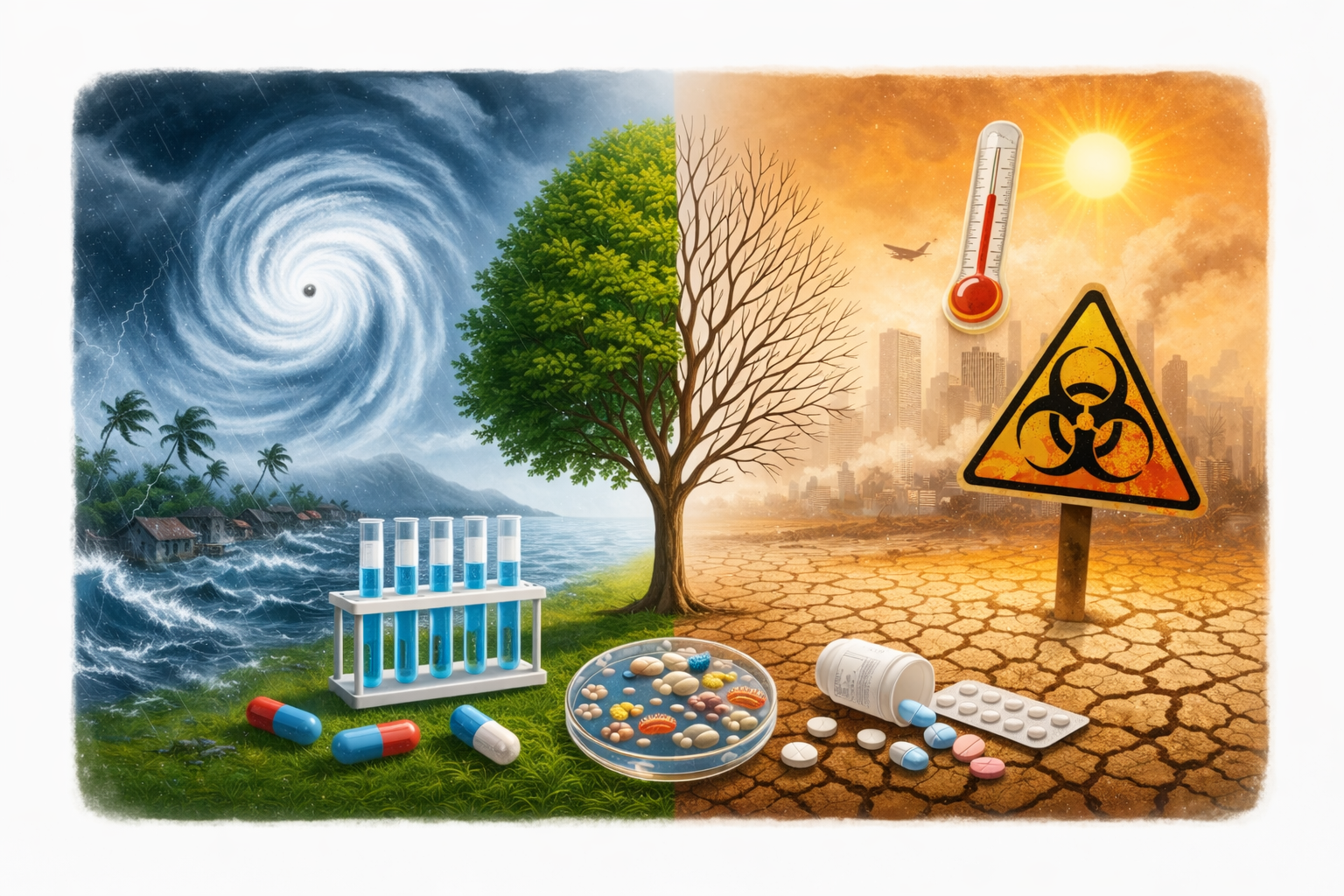
A new study warns that climate change could be accelerating the spread of antimicrobial resistance (AMR) in the Western Pacific region, creating a serious and complex public health threat. While previous research has suggested links between rising temperatures and drug-resistant infections, this study brings fresh attention to how climate and socioeconomic factors interact to influence AMR-related deaths.
By combining findings from a systematic review with regional statistical analysis, researchers found that higher temperatures and increased rainfall are generally associated with rising AMR mortality. Warmer conditions may promote bacterial growth, while extreme weather events—such as typhoons and floods—can disrupt healthcare systems and increase inappropriate antibiotic use. However, climate is only part of the story. The study highlights that healthcare capacity, governance quality, economic stability, and population density strongly shape how climate factors affect resistance patterns.
The Western Pacific faces challenges. According to the World Health Organization 2023 AMR self-assessment survey, many countries in the region have developed National Action Plans on AMR, but few have updated them or established strong monitoring and evaluation systems. Only a limited number regularly collect cross-sector AMR data. This patchy surveillance makes it difficult to design targeted, evidence-based policies.
To address this gap, the researchers propose creating a regional AMR–climate monitoring network modeled on the Global Antimicrobial Resistance and Use Surveillance System (GLASS). Unlike existing systems, this proposed network would specifically integrate climate data, environmental pollution indicators, and resistance surveillance. Using big data tools, it could track real-time trends, detect emerging hotspots, and produce regular regional assessment reports.
The study also emphasizes the need for a “One Health” approach, supported by the World Health Organization and its Quadripartite partners—the Food and Agriculture Organization of the United Nations, United Nations Environment Program, and World Organization for Animal Health. This framework recognizes that human, animal, and environmental health are closely connected and calls for coordinated action across sectors such as healthcare, agriculture, environment, and education.
Socioeconomic inequalities further complicate the picture. Low-income countries often face shortages of trained health workers, weak enforcement of prescription rules, and limited resources for climate adaptation. During climate-related disasters, antibiotic misuse may increase, worsening resistance.
Strengthening climate-resilient health systems, improving antibiotic stewardship, enhancing workforce training, and promoting regional cooperation are key recommendations. These efforts align with global development goals, including United Nations Sustainable Development Goals on health, climate action, and reducing inequality.
The authors conclude that tackling AMR in a changing climate requires integrated surveillance, stronger governance, and cross-border collaboration to protect the region’s future health and economic stability.
Ref: Lancet Reg Health West Pac. 2025;67:101772. DOI: 10.1016/j.lanwpc.2025.101772